Mortgages

Bollard likely to keep interest rates steady

Continuing uncertainty about how Europe's debt crisis will be resolved combined with benign inflation locally means Reserve Bank governor Alan Bollard is likely to hold interest rates steady this week.

Monday, January 23rd 2012

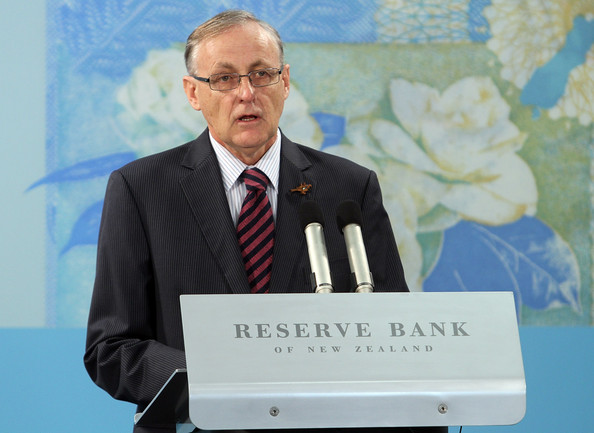
Reserve Bank governor Alan Bollard

And, as economists continue to push their expectations of when he will next raise rates further into the future, there's even a chance Bollard will change his tightening bias to neutral.

All 13 economists surveyed by www.mortgagerates.co.nz expect no change on Thursday when Bollard reviews the official cash rate (OCR) which currently stands at a record low of 2.5% where it has remained since March in the wake of Christchurch's devastating earthquake.

Economists are currently evenly divided as to whether the first OCR hike will come in September or December. Craig Ebert at Bank of New Zealand, whose current pick is September, says the risk is it will remain unchanged into next year.

Ebert says while it's possible Bollard will move to neutral, he doesn't expect that will happen.

"He may give some ground in respect of some of the domestic issues," but the European situation now is no worse than when Bollard released his last monetary policy statement (MPS) in December.

Annette Beacher at TD Securities says last week's weaker than expected inflation data - the consumer price index fell 0.3% in the December quarter compared with market and Reserve Bank expectations of a 0.4% increase - will simply provide Bollard with additional comfort about holding rates.

Beacher has pencilled in a 50 basis point OCR rise to 3% for December this year "but risks of slippage into 2013 are high as unstable ground potentially delays the full-scale repairing and rebuilding of Christchurch."

Matt Nolan at Infometrics says there's even a very outside chance Bollard may cut the OCR - certainly the wholesale financial markets are attempting to price in a cut.

The strength of the New Zealand dollar - it is more than two US cents higher than when the MPS was released on December 8 - and the weak recent domestic data, including weak retail sales, could be used to justify a cut, Nolan says.


Most Read

AIA - Go Home Loans 4.00
Unity First Home Buyer special 4.15
SBS FirstHome Combo 4.29
ICBC 4.49
Kainga Ora 4.59
SBS Bank Special 4.69
China Construction Bank 4.85
Co-operative Bank - First Home Special 4.89
Unity Special 4.99
TSB Special 4.99
Westpac Special 4.99
Kainga Ora 4.95
China Construction Bank 4.95
ICBC 4.99
SBS Bank Special 5.29
ASB Bank 5.35
ANZ Special 5.35
TSB Special 5.35
BNZ - Std 5.35
AIA - Go Home Loans 5.35
Westpac Special 5.39
Co-operative Bank - First Home Special 5.39
SBS Bank Special 5.49
Westpac Special 5.59
ICBC 5.65
Kainga Ora 5.69
BNZ - Std 5.75
ASB Bank 5.75
AIA - Go Home Loans 5.75
Kiwibank Special 5.85
TSB Special 5.85
ANZ Special 5.89
Co-operative Bank - First Home Special 5.89
SBS FirstHome Combo 3.29
AIA - Back My Build 3.34
SBS Construction lending for FHB 3.79
CFML 321 Loans 4.20
ICBC 5.39
Co-operative Bank - Owner Occ 5.69
Co-operative Bank - Standard 5.69
Kainga Ora 5.79
Pepper Money Prime 5.99
Kiwibank 6.25
Kiwibank Special 6.25

More Stories

Can the NZ economy grow while house prices stagnate?

Thursday, July 09th 2026

Can the NZ economy grow while house prices stagnate?

The question of whether the New Zealand economy can grow much without a recovery in the housing market remains a live issue.

Thursday, February 19th 2026

RBNZ expects slower house price growth in the current recovery

The Reserve Bank thinks house prices will rise at a much slower pace during the current recovery than they have in past cycles.

Wednesday, January 07th 2026

Queenstown not off the radar for first home buyers

First home buyers are not being deterred by Queenstown’s soaring house prices.

Record levels of first home buyers taking out low deposit loans

Tuesday, December 23rd 2025

Record levels of first home buyers taking out low deposit loans

About half of all first home buyer lending has been done at a less than 20% deposit in recent months.

